Triyan Insurtech
ProductFor InsurersFor SurveyorsFor WorkshopsFor Claimants
LoginRequest a Demo
Product

Triyan in Action

One claim, end to end — and every report it produces.

A 5:28 film, music only. The insurer files the claim and names the garage, the garage sends its papers and the insurer watches them arrive. The owner records an AI Survey on their phone, and the AI layer works at every step after that — tracing the damage on the photographs, issuing the AI Assessment Report and the ILA, filling the assessment from the dealer's bill, flagging an over-billed part, checking compliance and drafting the reply to the insurer's query — while the surveyor confirms every figure.

Your browser cannot play this video. Download it instead.

The case in the film is illustrative — the insured, the garage and the surveyor are demo accounts, the documents are specimens and the insurer is a sample name. The screens and the arithmetic are the real product; the AI's answers come from a demo connection that reads the specimen documents shown.

What's in this film
  1. The insurer files the claim; the workshop sends the papers; the insurer watches them arrive, with turnaround clocks.
  2. The routing agent ranks the surveyors; an admin assigns. The surveyor's dashboard: a worklist and charts.
  3. The claimant joins the claim: the surveyor asks for papers and the AI Survey, and sends one link.
  4. On a phone: the claimant unlocks with the vehicle number, follows the stages, uploads papers, asks a question; the surveyor answers on the Queries page.
  5. The claimant's guided AI Survey: nine steps, then send.
  6. Document Intelligence fills the Final Report; the surveyor confirms each field.
  7. Photos sorted, damage detected and traced, time and place checked.
  8. The AI Assessment Report and the Initial Loss Assessment.
  9. The estimate and bill read into the assessment; policy, cost and evidence agents check it.
  10. Ask the file — answered from the documents.
  11. Work approval sent to the garage and acknowledged there.
  12. Invoice with the GST check; report generated and checked by Compliance QC; nine report engines.
  13. Submitted and downloaded by the insurer; the claimant's timeline ticks to report submitted.
  14. The insurer's query, with a drafted reply from Discrepancy Resolution.
  15. AI Lab: cost of every AI call, risk sweeps, nightly rounds, fee reminders and the eleven agents' track record.

Nine report engines, one claim.

Every report is built from the same claim record, so none is retyped from another — change a line once and every report that uses it changes with it.

1Final SurveyReport2Spot SurveyReport3MUL BillCheck4HindiLetter5IDVValuation6Nil DepClaim7RTI Net ofSalvage8AIAssessment9Initial LossAssessment9report enginesone claim
  1. 1Motor Final Survey ReportDamage, depreciation, GST and the net claim payable.
  2. 2Spot Survey ReportWritten at the site, before any repair work starts.
  3. 3MUL Bill Check ReportThe garage's bill checked against what was assessed.
  4. 4Hindi Motor Requirement LetterTo the insured, in Devanagari, for the documents still missing.
  5. 5IDV / Valuation ReportWhat the vehicle was worth, and whether it is a total loss.
  6. 6Nil Depreciation Claim ReportThe same assessment priced for a zero-dep policy.
  7. 7RTI Net of Salvage LiabilityReturn-to-invoice and net-of-salvage settlement for a total loss.
  8. 8AI Assessment ReportThe AI's read of an AI survey's photographs and video, confirmed by a person.
  9. 9Initial Loss Assessment (ILA)The first figure the insurer sees, worked out by the same rules as the final report.
Why it exists

Built to cut report time by 80%

The survey has always taken an afternoon. It was the paperwork afterwards that took the evening — the same figures typed into six documents, each one a chance to make an arithmetic slip nobody catches until it has been filed.

That evening is what this product is for. Enter the findings once; the documents assemble themselves, the agents check them, and a surveyor signs off work they can still stand behind.

What you get

Six things a generic claims tool doesn't do.

The arithmetic

It does the sums, and shows the working

Depreciation by IMT-23 category, GST per line, insured-share splits, salvage and excess — all computed as figures are entered, not afterwards in a spreadsheet. Every category subtotal reconciles against the whole.

Labour, painting, metal, rubber, glass and plastic each carry their own rule.

The evidence

Three photo stages, tagged as you shoot

Initial survey, under repair, reinspection — captured separately, with GPS and timestamp where the device gives them. A claimant can be sent a capture link and photograph their own vehicle without an account.

An agent flags a priced repair with no photograph behind it, while you can still take one.

The documents

Six documents from one set of figures

Final Survey, Spot, MUL Bill Check, Hindi Motor Requirement Letter, IDV Valuation and Nil Depreciation. None of them is retyped from another — change a line on the sheet and every document that uses it changes.

Including the Hindi letter, generated in Devanagari rather than transliterated.

The machine

Eleven agents, and not one of them decides

They read the documents and photographs, check each photo's time and place, price the lines against this firm's own approved repairs, check compliance, sweep the caseload for risk, rank surveyors for an unassigned case, draft the reply to an insurer's query, check the GST, chase the fees and do the rounds every night.

Every figure on a filed report was accepted by the surveyor whose name is on it.

The record

Nothing is silently overwritten

A submitted report that is later edited leaves a visible trail — who, what, when. Fee invoices generate from the same data as the report, so the bill and the assessment cannot disagree.

Generating and submitting are two deliberate steps, so a draft can be revised freely.

The access

One record, three views

A surveyor sees their own caseload. Admins see the firm nationwide. An insurer sees only their own cases, read-only, once submitted — and can raise a query against a figure without a phone call.

Admin accounts require a second factor at sign-in; every sign-in is logged.
Sample Report

See what an insurer receives.

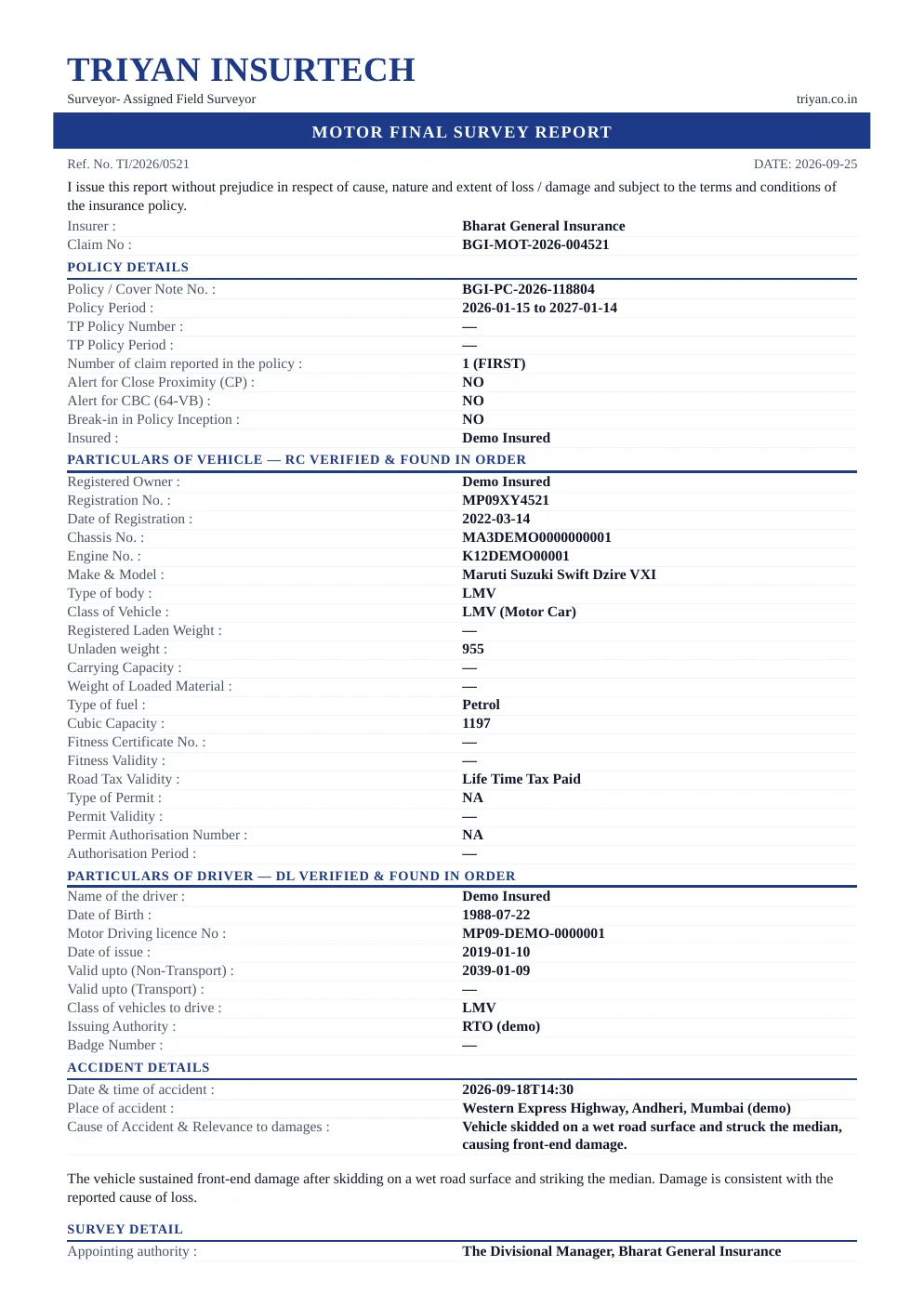
Page one of a Motor Final Survey Report, exactly as our report engine produces it, for a demo claim. The full report — assessment sheet, invoice and all — is yours to walk through in a demo.

PDFMotor Final Survey Report — demo claimPage 1 of 5
REQUEST FOR DEMO
Page 1 of a sample Motor Final Survey Report: insurer, policy, vehicle, driver and accident details for a demo claim

Demo claim with invented details; Bharat General Insurance is a sample insurer name.

Let's talk about your claims.

Whether you're an insurer evaluating a survey partner, a surveyor interested in membership, or a workshop — tell us a little and we'll come back to you directly. Waiting on your own claim's tracking link? Tell us here too.

Which of these is closest?

We'll use these details only to reply to this enquiry. We don't sell them, and we don't add you to a mailing list.

Or email us at contact@triyan.co.in.

Already using Triyan? Sign in here.

Triyan Insurtech

Claims survey and loss assessment on one platform for workshops, insurers, surveyors and claimants — with AI agents doing the work and a human approving every report. Reach out to us at contact@triyan.co.in

Company

About TriyanOur PortalsWhat We DoHow It WorksContact

Work With Us

For InsurersFor SurveyorsFor WorkshopsFor ClaimantsLogin

Guides

What a motor final survey report containsDepreciation and IMT-23, explainedThe India Motor Tariff 2002 (full text)How long a claims survey takesDocuments needed for a motor claim surveyAll guides
© 2026 Triyan Insurtech. All rights reserved.triyan.co.in